

Pelevin had me from the word go.
Loved it.
And a little Hungarian absurdity of my own: I read a Russian novel in Hungarian, and now I’m writing about it in English.
Only someone who has lived it can really understand Eastern Bloc absurdity. We Hungarians had Moldova and Örkény. The Russians had… well, a few dozen writers. And Pelevin has the bloody nerve to be this good at it.
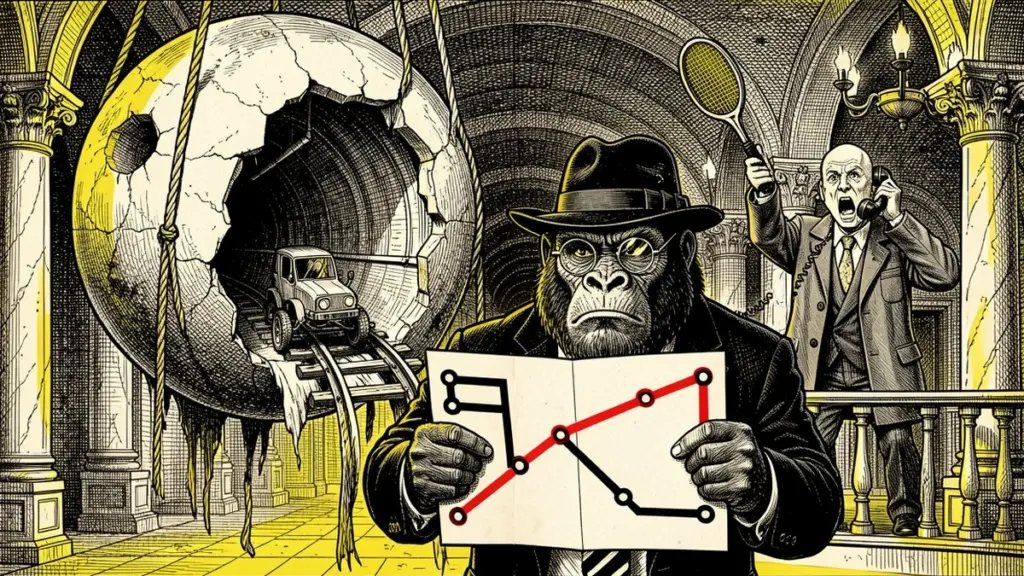
Halmuradov is worried he’ll miss tennis again. Omon still has to deploy the radio beacon that will broadcast “PEACE”, “LENIN” and “USSR” into space. Then he has to die. That’s the mission’s ultimate objective: three slogans on repeat. This makes the mission pointless even in its official version, and it would remain just as pointless if they really were carrying it out on the Moon. What bothers the commander is how long it’s taking. He hurries Omon along over the phone and even demands to know whether he ever thinks of anyone else. The young man preparing to die is supposed to show some consideration for the officer’s leisure plans. There’s paperwork holding Halmuradov up, too: until the job is done, he can’t close the file. In a few sentences, Pelevin shows us exactly how much heroic sacrifice means to the man ordering it. [1]
The commander’s problem is having to wait. The hero’s is that afterwards, nothing will ever be waiting for him again. Yet Halmuradov is so smug in accusing Omon of selfishness that you’d think the boy was holding him up out of pure spite. The officer invoking collective duty is worried about his tennis slot. That makes the scene funny, but Omon has a pistol to put to his own head, and it has to be factored into every laugh.
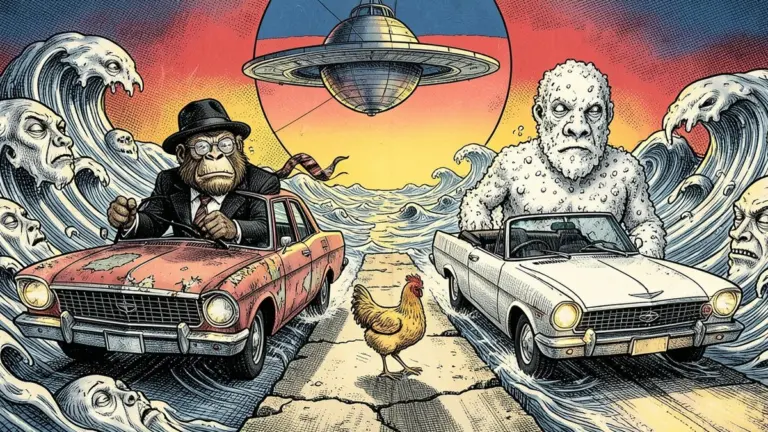
Several times while reading Omon Ra, I thought I’d finally worked out what Pelevin was doing. I noted three successive shocks; the same shorthand did for all three: WTF. First, the way the world works becomes impossible. Then the explanation of what’s happening falls apart. Finally, the place from which I’ve been watching it all changes. Each time, the author gives me a little while to settle into the new interpretation. The next twist finds me sitting there quite comfortably.
The Price of Human Material
At first, the Soviet setting feels familiar. There’s the claim of technological superiority, and there’s the shoddy material reality. In between, people work, make excuses and obey. One phrase comes to mind for the whole system: total crap. The crudeness is more useful here than some carefully chosen term from political science. It covers the botched jobs, the knock-offs, the fabricated achievements, and the shame all of this might cause if anyone were actually obliged to feel any.
The people involved pick up the bill for the technological shortcomings. If human labor has to replace a machine’s ability to function on its own, the system will find someone. Pelevin takes this literally. Each rocket stage is separated by hand, by a cadet who goes down with it. The lunar rover is a bicycle frame with pedals, and Omon is its engine. At the Maresyev Flight Academy, the cadets have their legs amputated so that they can live up to the legless war hero the school is named after. [6] If the job offers no way back, the system will also find a moral explanation. Willingness to sacrifice can be used as a spare part. Omon’s enthusiasm is valuable: his own dream helps him accept work he would run from under other circumstances.
The novel inherits a mentality from the Second World War: human material beats technology. Evidence of scarcity and backwardness can be rewritten as evidence of the people’s moral superiority. Where another state would use a machine, the Soviet citizen volunteers to die. The question of why the country is behind suddenly becomes a question of who is willing to die for it. Anyone who insists on the original question has a character defect.
The same brand of heroism turns up in the gamekeeper’s account of his son’s death, which he tells the cadets. After a wild boar kills a leader, men wearing animal skins and bulletproof vests take the place of game on the hunts. For Kissinger, the gamekeeper and his son, Marat, play the two bears. The American’s gun misfires, so he goes at Marat with a knife; mindful of the responsibility entrusted to him, the boy stays in character, and the blade slips through a gap in the vest. An honor board is laid across father and son to make a tabletop. Above their bodies, the guests drink and conclude their agreement. By the time the party leaves, Marat is dead, a hero’s medal gleaming on his bearskin. [2]
The problem to be solved here is that hunting is dangerous for people who want to hunt. The organizers solve it by putting other people in danger. The hunt can go ahead, the distinguished guest is satisfied, and the boy’s death becomes a tale of heroism. Faking technological progress requires Omon’s body; staging a successful hunt requires Marat’s. Pelevin explicitly connects the two stories: during his suicide attempt, Omon thinks of Marat and realizes that Kissinger knew about the deception. [2]
Heroism has a peculiar double nature within this logic. A person’s courage, endurance and fear are real. The fact that the whole enterprise is a lie doesn’t cancel out what they experienced. That is what makes the story cruel. Omon has something to lose, and so did the other boys; the commanders put real desires to work. Take the dream out of it, and the situation would be much easier to judge. The coercion would remain visible, and the character wouldn’t have to fight his way through his own enthusiasm to recognize it.
It would be easy to say that human life has no value here. That needs a qualification. To the system, human life has a use value. It can plug gaps in technology, substantiate claims of achievement, teach others to obey. Omon’s life is needed for as long as the mission requires it. Halmuradov’s tennis can begin once the mission is over. The commander is managing his schedule, and the remainder of one man’s life fits neatly ahead of another man’s afternoon plans.
Three Lives with the Wrong Pedigree
At Mityok’s reincarnation examination, the explanation we’ve built up so far stops being enough. Omon is listening to a recording, his friend is speaking, and suddenly we leave the Soviet present for Mesopotamia. The account is so matter-of-fact that, for a while, the reader isn’t even sure they’ve followed the transition correctly. The examination treats previous lives as more information to attach to the applicant’s personnel file.
Three earlier lives unfold on the recording. Ninhursag is a future priest and seal engraver in Mesopotamian Aratta; Sextius Rufinus is a Roman poet descended from freed slaves; Vogel von Richthofen is a fighter pilot in Nazi Germany. [3] The first effect of this list is sheer absurdity. The second is the realization that, within the examination’s own logic, it all makes perfect sense. Once you’re assessing the political reliability of an immortal soul, three previous lives belong in the personnel file.
It is the worst pedigree imaginable: aspiring priest, poet, Nazi pilot. Through the Soviet examiner’s eyes, there’s something suspect in every one of them, and these far-flung lives pile up against each other in the final assessment. Mityok has a dodgy past before he’s even born. All his present efforts to fit in can be held up against a past he doesn’t remember, didn’t choose, and for which the examiner supplies all the evidence.
“Unreliable throughout all his lives” is my phrase, not the examiner’s, but it is what his verdict amounts to. At last, a person can be vetted across several lifetimes, and this immediately becomes a disadvantage. It produces a thorough form of guilt by ancestry: even death doesn’t stop the background checks. A new life doesn’t mean a clean slate. Every previous name can be attached to the same person, and the file is interpreted by those who also control his current life.
The tape ends with Mityok being led down a steep staircase towards a dead end, and soon afterwards his cot is taken out of the dormitory. [3] I am tempted to link his death to the examination’s findings, but the novel supplies no verdict attributing it solely to his Nazi past. That uncertainty is part of the scene’s effect. Omon is allowed to listen to what happened to his friend; listening gives him no say in it. The reader, too, gains access to the material while part of the decision-makers’ reasoning remains hidden. And you don’t get to complain about the missing explanation.
Reincarnation also takes the story beyond its Soviet timeframe. Situations involving sacrifice and the Moon recur in the earlier lives, and Mityok recognizes his examiner as someone who held power over him before. [3] The names and periods change; the subordination repeats itself. Omon’s own name works the same way. His father, a policeman all his life, named him after OMON, the special police units; Ra he chose for himself as a boy, out of his aunt’s atheist encyclopedia, because the god had a hawk’s head and the radio called pilots and cosmonauts the Motherland’s hawks. [7] Even the name he picked for himself took its cue from the radio. Mityok has several lives, but that doesn’t improve his odds. Vetting reaches a point where the person under scrutiny knows less about himself than his examiner claims to know. Even protesting becomes an odd business: how do you defend yourself against a biography you can’t even read without someone else’s permission?
Three Realizations
After the first shock, when the way the world works becomes impossible, I still believe the story can be explained. The system is cruel, technologically backward, and uses the people living under it for its own purposes. There’s room for the reincarnation examination in that picture, too, if we accept the novel’s rules. The reader gets used to the absurd. I build a new sense of order: this is how things work here, so this is how we have to read.
The second shock comes at the end of the mission, when the explanation of what’s happening falls apart. Omon’s gun misfires, and he survives. The pointlessness of his death was already built into the mission’s objective: broadcasting three slogans gave his sacrifice no meaning. Now even the location becomes uncertain, along with everything he was told about the journey.
The third shock changes the place from which I’ve been watching it all: Omon has been in Moscow. The vast distance of outer space disappears from the story, but the fear and suffering remain. The revelation doesn’t bring Mityok back, and it doesn’t undo what Omon has endured. A person can die even when the explanation of the world that makes his death necessary is entirely false.
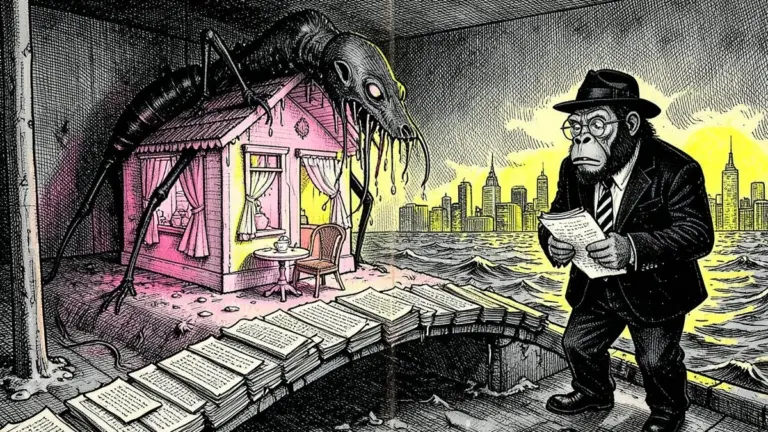
Pelevin knows how easily a reader mistakes the first discovery of a lie for possession of the truth. Once we’ve spotted the fraud behind the claims of technological achievement, we’re inclined to feel pleased with our own perceptiveness. We know what’s going on now. My first note on the book read: “we seem to get it.” Seen from here, the “seem” was doing all the work. The novel’s next twist takes aim at that comfortable state. It turns out our previous explanation could only take us so far.
That’s why the ending sends you back through the book. Details that previously seemed strange, clumsy or excessive acquire a new context. Something we initially accepted as evidence of Soviet shoddiness may later point to the nature of the whole enterprise. The narrative leaves that work to the reader: look again at what we accepted, and especially at our reasons for accepting it. Our own good explanations helped us keep going.
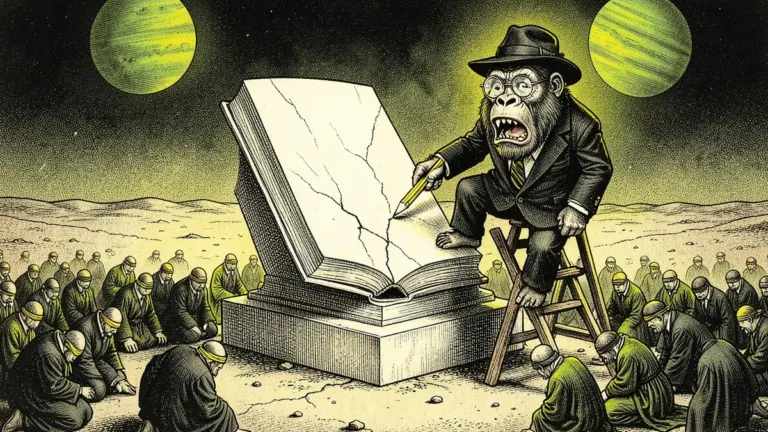
As a piece of writing, the twist rearranges the decisions we made while reading. That interests me most. Absurdity is no achievement in itself; jumbling events at random can easily be a writer’s get-out clause. In Omon Ra, what we learn later changes what we experienced earlier. A second reading has work to do.
The Moon and Its Meanings
I loaded the Moon with meanings before the novel did. The mission’s destination, a place ideology wants to claim, the idea of the dark side; and straight away, there’s the Pink Floyd association. The cosmic distance magnifies the emptiness of the objective. The state wants to travel all that way so it can say its own name and proclaim its own truth one more time. Omon’s entire life is earmarked for making this possible.
Eventually, the Moon means too many things for a single explanation to settle the matter. It is the object of Omon’s desire, part of the commanders’ program, and an image that stirs the reader’s cultural memories, all at once. The novel’s deception doesn’t affect these meanings equally. What we know about the destination can collapse while the desire attached to it remains valid. He really did want to get somewhere, even if the account he was given of the journey was false.
The problem is how quickly I turn my own cultural association into the meaning of the text. Pink Floyd comes to mind, so I’ve cracked it. I assign dreams or freedom to the Moon, communism to red, and consider the interpretation finished. That kind of automatic reading shuts the work down too soon.
An association can be useful without having a monopoly. We have to ask what it answers in this particular story, and what it leaves untouched. With Pelevin, settling too quickly on a symbol’s meaning is especially uncomfortable, because the object’s position and use may change. The same motif behaves differently in the hero’s desire, in the official explanation, and after the ending. If we stick the same meaning on it everywhere from the moment we first recognize it, the change itself is what we’ll miss.
On the Red Line
At the end, the red line is part of a subway network. Omon has to find out where he is on it and decide where he wants to go. [4] Throughout the mission, his route and his tasks were prescribed; now he is looking at a map with several stations on it. The color’s political meaning can be read into the scene, but the practical task remains: he has to work out where he is.
The ending works because surviving doesn’t settle what comes next. We don’t know what sort of life Omon will be able to build, and the world he has lived in hasn’t disappeared around him. All the story gives him is a choice he has to make. That is a surprisingly large change for someone who has been prepared for compulsory death in the language of voluntary service. Now he can at least ask where he would like to get to within the next few stops.
There’s another line I copied out of the novel: “how was I to know that the best things in life are always seen as if from the corner of one’s eye?” [5] As a reader, I find it hard to separate this from Omon’s single-minded pursuit of his goal. If you keep looking towards a prescribed point in the distance, what happens right beside you can only slip in at the edges. Against the weight of a grand objective, an ordinary day is easy to dismiss as insignificant. Halmuradov knows perfectly well that an ordinary day is valuable. It’s just that his day counts, and Omon’s is expendable.
That is why the accusation of selfishness remains the most disgusting part of the tennis conversation. The commander expects a man preparing to die to be considerate towards him. Omon’s fear is an inconvenience, his instinct to survive is stalling, and the unfinished task is a paperwork problem. This arrangement has all the moral vocabulary it needs: duty, courage, community, sacrifice. None of those words costs Halmuradov a thing.
Omon is still only looking at the map. It doesn’t give him his past back, and he knows little about the next station. The mission had scripted his final minutes. Now he has time to think about where to go next.
Source Notes
[1] Viktor Pelevin, Omon Ra, chapters 6 and 15: the radio beacon’s message and Halmuradov’s remarks about tennis. The scene descriptions are paraphrases; the beacon’s quoted wording follows Yuri Machkasov’s English translation. Russian text, chapter 15; English translation by Yuri Machkasov.
[2] Ibid., chapter 8: Marat and the staged bear hunt; chapter 15: Omon’s realization about Kissinger. Russian text, chapter 8; Machkasov’s English translation.
[3] Ibid., chapter 10; Mityok’s empty cot: chapter 11. The original names are Нинхурсаг, Секстий Руфин and Фогель фон Рихтгофен. The Latin-alphabet forms have been checked against Machkasov’s translation. The phrase about being unreliable throughout all his lives is my own description, not a quotation from the novel. Russian text, chapter 10; Machkasov’s English translation.
[4] Ibid., chapter 16: the novel’s closing scene, paraphrased here. Machkasov’s English translation.
[5] Ibid., chapter 14. The English quotation follows Yuri Machkasov’s translation. The corresponding passage in László Bratka’s Hungarian translation is also quoted in Könyvelvonó, “Viktor Pelevin: Omon Ré,” June 18, 2024.
[6] Ibid., chapter 5: the amputations at the Maresyev academy; chapter 8: the rocket stages separated by hand; chapter 9: the bicycle-powered lunar rover. Machkasov’s English translation.
[7] Ibid., chapter 1: the name Omon and the father who chose it; chapter 9: Ra, the hawk-headed god. Machkasov’s English translation.
Leave a Reply